
Failure to Yield to Emergency Vehicles in Virginia
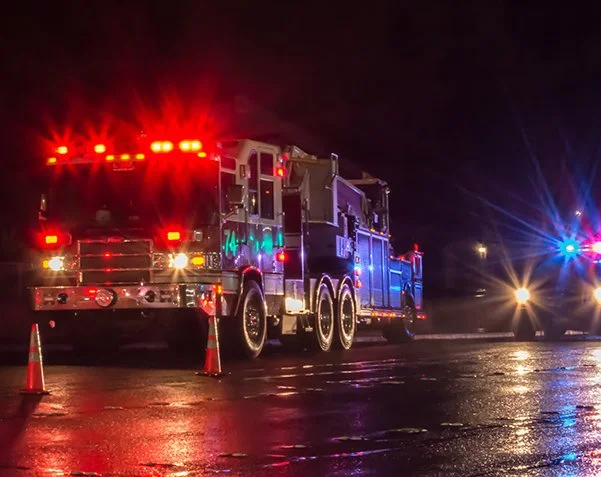
When you see emergency lights, what you do next matters.
That became painfully clear in Campbell County on August 6, 2026, when Appomattox County Sheriff’s Deputy Burlie W. Duvall III was killed while assisting at a crash scene on Route 460. Virginia State Police reported that emergency equipment was activated when a tractor-trailer approaching the scene swerved and struck Deputy Duvall. Seven others were also taken to area hospitals.
It was a devastating loss for his family, fellow officers, and the surrounding community, and a sobering reminder of how quickly conditions can change around an emergency scene. Drivers should slow down, stay alert, and give first responders as much room as possible.
If you have been cited or charged following a failure-to-yield or emergency-vehicle incident in the Lynchburg area, Battlefield Law Group can review the specific charge, the circumstances of the stop, and the Virginia code section involved to help you understand what you are facing.
What Are You Required to Do for an Approaching Emergency Vehicle?
Virginia Code § 46.2-829 applies when an emergency vehicle is approaching with its audible signal and emergency lights activated.
Drivers are required, as quickly as traffic and road conditions safely allow, to move toward the nearest edge of the roadway, clear an intersection, and stop until the emergency vehicle has passed unless directed otherwise by law enforcement.
That does not mean making a sudden or unsafe maneuver. The safest response is to recognize the emergency vehicle early, reduce your speed, check the traffic around you, and move out of its path when it is safe to do so.
A violation of this section can result in a failure-to-yield charge. If a driver overtakes or passes a moving emergency vehicle while its siren and warning lights are activated, the conduct can rise to reckless driving.
What If the Emergency Vehicle Is Already Stopped?
A stopped emergency scene is different from an emergency vehicle approaching from behind.
Virginia has a separate law addressing drivers who approach certain stationary vehicles displaying flashing lights. On qualifying multilane highways, drivers are generally expected to move into a lane that is not adjacent to the stopped vehicle when it is reasonable and safe to do so. If changing lanes is not safe, the driver must proceed with caution at a safe speed.
This is why “move over” and “failure to yield” are not always the same thing legally, even though people often use the phrases interchangeably.
Not Every Failure-to-Yield Charge Is the Same
Virginia has several different traffic laws involving the right-of-way, and the exact code section listed on a summons matters.
Attorney Rob Yurkowski recently handled a case involving a failure-to-yield allegation in a construction zone where the specific law cited became an important issue in the case. That situation was different from failing to yield to an approaching emergency vehicle, but it highlights an important point: two tickets that sound similar may involve different statutes and different legal questions.
Where the incident happened, whether the vehicle was moving or stationary, whether emergency lights were activated, whether the driver was in a work zone, and what traffic controls were present can all matter.
If you received a citation, one of the first things to look at is the exact code section written on the summons.
Why Consider Hiring a Lawyer for a Failure-to-Yield Ticket?
It can be tempting to simply pay a traffic ticket and move on, especially if it does not initially seem serious.
But paying a Virginia traffic citation generally means resolving the charge without challenging it. Depending on the offense, a conviction may affect your driving record, carry DMV demerit points, or have additional consequences.
A traffic attorney can review the summons, the statute you were charged under, the facts surrounding the stop, and any available evidence before you decide how to handle the case.
That can be especially important when a failure-to-yield allegation involves an emergency vehicle, a construction zone, conflicting accounts of what happened, or conduct that could potentially be charged as reckless driving.
Traffic Defense in the Lynchburg Area
Battlefield Law Group represents drivers facing traffic charges throughout Lynchburg, Campbell County, Bedford County, and the surrounding Central Virginia communities.
Rob Yurkowski handles traffic matters throughout the Lynchburg area, including failure to yield, reckless driving, speeding, and other Virginia traffic offenses.
If you received a ticket and are unsure what the charge means or whether you should simply pay it, having the citation reviewed can help you understand what you are actually facing before you make that decision.
